


Best Caravan Tow Mirrors for Australian Drivers in 2026
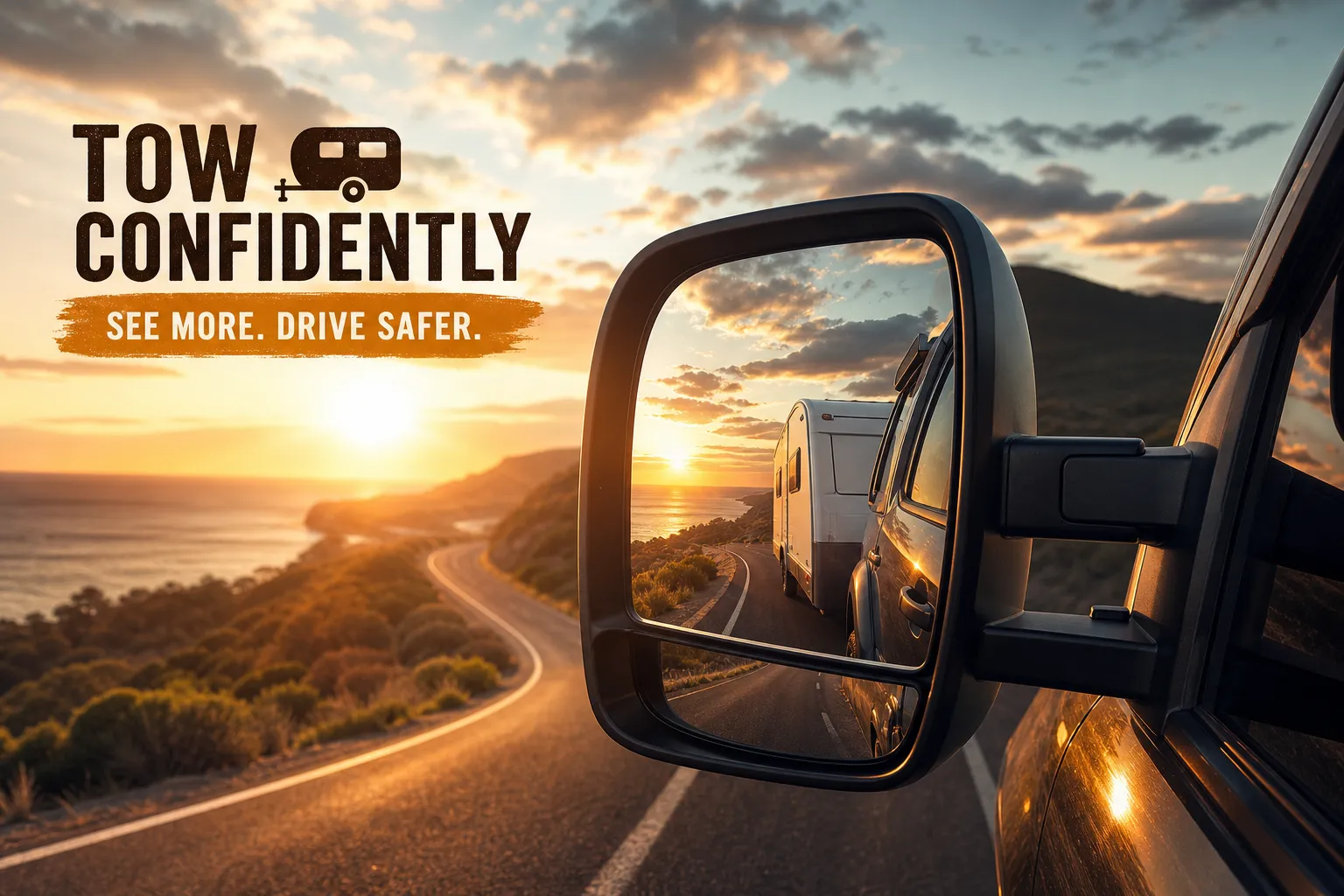
The moment you hitch up a wide caravan, caravan tow mirrors become essential, your factory mirrors turn almost useless overnight. Your side view shrinks, your blind spots grow, and before you've even pulled out of the driveway, you're already legally exposed. It's one of those problems that catches first-time towers off guard, yet experienced drivers know to solve it before every trip.
Caravan tow mirrors aren't just a comfort upgrade. When your van is wider than your tow vehicle, fitting extended mirrors isn't optional under Australian law. They restore the rearward field of view you're legally required to maintain, and choosing the wrong pair means you'll deal with vibration, wind noise, poor visibility, or a mirror that doesn't seat properly on your vehicle.
This guide covers everything you need to make the right call: the legal requirements, what separates a quality mirror from a frustrating one, how to choose between clip-on and direct-replacement styles, what to expect on price, and how to check your mirrors are safe before you drive. If you want to skip straight to fitment options for your specific vehicle, the team at Brixton 4x4 stocks leading brands including Clearview with model-specific fitment for popular Australian tow vehicles, and their online chat makes it easy to confirm compatibility before you buy.
When Australian law says caravan tow mirrors are not optional
The national rear-vision standard that applies everywhere
Australia operates under a uniform rear-vision standard set out in ADR 14/02, which serves as the national technical benchmark applied across every state and territory. States and territories reflect and enforce this requirement through their own road rules and guidance, so in practical terms the standard is consistent nationwide. ADR 14/02 requires that drivers maintain a clear rearward field of view alongside and behind the vehicle combination. Specifically, mirrors must allow the driver to see a 4-metre-wide horizontal strip of road on the passenger side, from 20 metres behind the driver's eye point out to the horizon. When a caravan blocks that view, you are legally required to fit mirrors that restore it. For a plain-English overview of how those rules apply when towing, see this guide to caravan towing laws.
The legal test is whether the required rearward field of view is obstructed. In practice, if your caravan is wider than your tow vehicle, it will generally block that view, which means towing mirrors are required before you drive. The width difference doesn't need to be dramatic for the standard to apply, and it's not worth gambling on the interpretation.
What states and territories say in practice

NSW states explicitly that extra mirrors may be needed when towing a large trailer, and that the driver must maintain a clear view of road and traffic. Victoria takes the same position, with enforcement focused on whether the driver can see ahead, behind, and to each side. South Australia follows the same principle, noting that towing mirrors are necessary when the trailer is wider than the vehicle. Queensland, WA, Tasmania, the NT, and the ACT operate under the same national standard rather than restating the rule separately.
The practical takeaway is simple: don't gamble on state-by-state interpretation. If your van pokes out beyond your door mirrors on either side, fit towing mirrors every time, regardless of where you're driving.
Choosing caravan tow mirrors: what separates a good one from a frustrating one
Field of view: seeing what matters behind you
Field of view refers to the width and depth of road you can see in the mirror glass when the arm is extended. For wider caravans, a mirror with a larger glass face or a convex element becomes increasingly important to maintain an adequate view of the lane and the trailer edge, the wider the van, the more coverage you need. Many quality mirrors combine both: a flat safety glass section that gives a true image of distance and a convex section that widens coverage at the expense of slight distance distortion. For towing, that combination works well in practice. For independent recommendations and comparisons, see Practical Caravan's guide to the best caravan towing mirrors.
Extension range: how far the mirror needs to reach
Extension range determines whether the mirror arm clears the side of the caravan. Budget clip-on mirrors often have a 31-centimetre arm, while wider-reaching options extend to 41 centimetres or more. Clearview's Next Gen mirrors for the LandCruiser 300 Series, for example, offer a telescopic extension of up to 180 mm beyond the factory mirror position. The practical rule is to measure the width of your caravan, compare it to the width of your tow vehicle at the mirror line, and estimate the extension required before you buy. If you drive a Ranger, check the Next Gen Ford Ranger towing mirrors: what to look for before you buy.
Electric vs manual adjustment
Manual mirrors are adjusted by hand, require no wiring, and suit occasional towers who want a simple, reliable solution. Electric mirrors, like those in Clearview's direct-replacement range, adjust from inside the cabin and generally retain OEM functions including heating. For regular or long-distance towing, electric adjustment is well worth the extra investment. You can fine-tune your mirrors on the move without stopping, which matters when conditions change and your van shifts load on a long haul.
Stability and wind noise at highway speed
Mirrors that clamp loosely or use cheap straps tend to vibrate and create wind noise at typical highway speeds. That's not just annoying. A mirror that buzzes and shifts makes it harder to pick up vehicles in adjacent lanes, which defeats the purpose entirely. Heavier-duty clamps, stabilising rods, and door-mounted designs reduce shake significantly. Practically speaking, a mirror that shifts under gusts from passing road trains is unsuitable for highway towing, choose a more stable mounting method if you're covering serious distance.
Clip-on or extendable caravan tow mirrors: which type suits your setup
How clip-on tow mirrors work and where they perform well
Clip-on mirrors attach to your factory mirror housing using straps, clamps, or brackets, usually without tools and in under 15 minutes per side. They're well suited to occasional towers, those who share a tow vehicle between uses, or anyone who doesn't want to modify the vehicle permanently. The trade-off is real though: clip-ons can shift at speed, create more wind noise, and may partially block part of the factory mirror depending on the housing shape. They're a practical entry point, not a long-term solution for regular towing.
Extendable and direct-replacement mirrors: the better long-term choice
Vehicle-specific replacement mirrors provide a precise fit, sit flush against the door, vibrate less, and look factory-fitted once installed. Installation takes 30 to 90 minutes per side and typically involves removing door trim and the factory mirror assembly, but the result is genuinely superior in every measurable way. These mirrors are the preferred option for regular towing, wide caravans, or anyone covering consistent highway kilometres through the outback or up the coast.
Matching the type to your vehicle and towing habits
Toyota LandCruiser, Nissan Navara, Mitsubishi Triton, and most other popular Australian tow vehicles have bolt-on replacement options available from brands like Clearview. Caravan mirror kits in this category are model-specific and deliver better stability and integration than universal clip-on alternatives. If you tow more than a few times a year, the investment in a vehicle-specific extendable mirror pays off quickly in comfort, safety, and reduced fatigue on long drives.
Getting the right caravan tow mirrors for your specific vehicle
Why vehicle-specific fitment matters
A mirror designed for a LandCruiser 300 Series won't mount cleanly on a Navara or Triton. Housing shapes, mounting points, and wiring connectors differ between makes and models, sometimes dramatically. Using the wrong mirror leads to fitment gaps, rattle, and sometimes the inability to fold or adjust correctly. Always confirm compatibility before purchasing. A fitment guide or a quick conversation with a specialist saves you the frustration of a return shipment and a delayed departure. For practical advice on why towing mirrors matter and how to choose a set, see this article on why you need caravan towing mirrors and how to choose a set.
Clearview: a leading option for direct-replacement towing mirrors in Australia
Clearview has established itself as a benchmark for direct-fit towing mirrors in the Australian market. Their Next Gen range covers vehicle-specific options for Toyota, Nissan, Mitsubishi, and other popular tow platforms, retaining OEM functions including electric adjustment and heating while extending the mirror arm to cover wider caravans. Folding function retention varies by application, so it's worth confirming which OEM features carry across for your specific vehicle before ordering. Clearview mirrors are built specifically for right-hand-drive Australian vehicles and backed by a 2-year warranty. In most standard installs, you won't need extra wiring harness adaptors, though it's worth double-checking if your vehicle has memory mirrors, puddle lights, or a camera. You can view Clearview's product range and model-specific options on the manufacturer site for further technical details: Clearview towing mirrors. For a more detailed walkthrough of Clearview fitment options and benefits, see our Clearview towing mirrors guide.
Where to find the right fit: Brixton 4x4
Brixton 4x4 stocks Clearview mirrors alongside other leading towing mirror brands, with model-specific fitment for vehicles including the LandCruiser 70, 200, and 300 Series, Mitsubishi Triton, Nissan Navara, Mazda BT-50, and more. Whether you're after a full caravan mirror kit or a direct-fit 4WD tow mirror upgrade, browsing by vehicle make and model on the Brixton 4x4 website narrows your options quickly and removes the guesswork around compatibility. If you're unsure which model suits your setup, the expert team is available via online chat to check fitments and advise on the right product for your specific vehicle. Brixton 4x4 also offers a price match guarantee and Australia-wide delivery, so you're not paying more than you should for a product that arrives at your door ready to fit.
What you should expect to spend
Entry-level options (from around $27, $200): the clip-on starting point
Entry-level clip-on mirrors from brands like Camec and basic strap-on kits cover a wide range at the lower end of the market, the most basic strap-on options start around $27, while better-built clip-on sets reach up to $200. These suit occasional towing or temporary legal compliance, but expect more vibration and limited adjustability. They're a starting point, not a destination.
Mid-range options ($250, $500): better fit, better build
Mid-range mirrors offer improved clamping systems, better glass quality, and more extension range. This bracket suits regular towers who want reliability without committing to a full mirror replacement. Options here often include convex safety glass and more robust arm designs, and they represent a meaningful step up from basic strap-on clip-ons in terms of day-to-day usability.
Premium direct-fit mirrors ($700, $950+): the long-term investment
Vehicle-specific direct-fit mirrors like Clearview's Next Gen range sit in this bracket, and the premium price buys OEM-level integration, electric adjustment from inside the cabin, retention of factory functions, and a genuine 2-year warranty. For anyone towing regularly or covering long distances, this tier eliminates every compromise present in cheaper options. The upfront cost looks very different when you're 800 kilometres into a Kimberley crossing and your mirrors haven't moved a millimetre.
Before you drive: fitting checks and on-road safety habits
Fitting clip-on mirrors: what to check before you leave the driveway
Clip-on mirrors should be seated evenly on both sides of the factory mirror housing with all straps tightened gradually and evenly, not one side at a time. Once fitted, shake each mirror firmly. Any movement means the straps need re-tensioning or repositioning before you go anywhere. Adjust the glass so you can see the side of the caravan and the lane beside it, then confirm the view from the driver's seat before you move.
Extendable mirror installation: the key steps
Extendable mirrors require removing interior door trim, disconnecting the factory mirror harness, and mounting the new assembly before reassembling the panel. Use plastic trim tools to avoid scratching door panels, and tighten mounting nuts evenly to avoid stressing the housing. Before you close the door panel back up, test all electrical functions including adjustment and heating. Finding a wiring fault after the panel is back on costs you twice the time. If you hit issues with wiring or camera alignment during fitment, our troubleshooting walkthrough on troubleshooting camera alignment issues during Clearview towing mirror installation may save you a lot of time.
On-road checks before hitting the highway
Do a slow-speed drive of 100 to 200 metres before merging onto open road. Confirm the mirrors hold their angle and don't vibrate at normal driving speed. If any mirror shifts or buzzes noticeably below 80 km/h, stop and re-seat or re-tighten before continuing. Check mirror alignment again after your first highway run, clip-on mirrors in particular can settle or shift slightly once exposed to sustained airflow, and a quick roadside check after 20 minutes is always worth the 90 seconds it takes.
Ready to fit the right mirrors and tow with confidence
The two decisions that matter most are mirror type and vehicle compatibility. Clip-on mirrors suit occasional towers on a budget; direct-fit extendable caravan tow mirrors are the right call for anyone towing regularly, covering long distances, or pulling a wide van. The rule is consistent nationwide: a caravan wider than your tow vehicle means towing mirrors are mandatory under ADR 14/02, whichever state or territory you're driving through.
Fitting the right caravan tow mirrors is one of the lowest-cost, highest-impact safety upgrades for any tow setup. The difference between factory mirrors and a quality extended set is the difference between guessing and knowing exactly what's beside and behind you at 100 km/h on the highway. That's not a small thing.
Head to Brixton 4x4 to browse Clearview and other leading towing mirror brands by vehicle make and model, including direct-fit 4WD tow mirrors and complete caravan mirror kits suited to the most popular Australian tow vehicles. If you want a fitment check or a personalised recommendation before you order, the team is available via online chat and ready to help you find the right set for your rig, with Australia-wide delivery and a price match guarantee as standard.