


Steel vs Alloy Bull Bar: Which Is Best for Your 4WD?
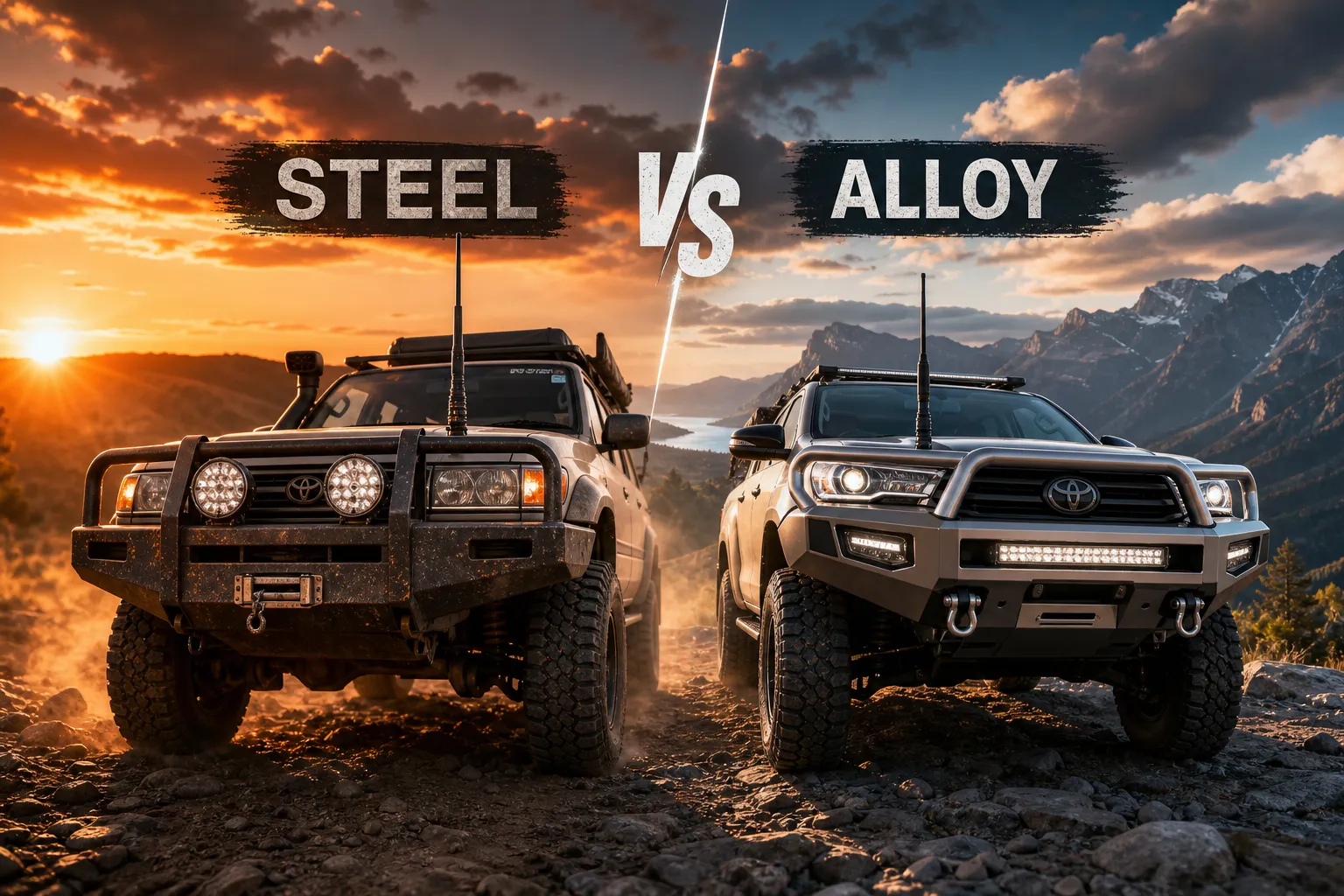
You've narrowed it down to two bars. Same vehicle, same hoop design, one in steel, one in alloy. The spec sheet tells you the weights are wildly different, the prices aren't the same, and the salesperson is giving you a pitch for both. Sound familiar? Choosing between a steel vs alloy bullbar for your 4WD comes down to five things: weight, strength, corrosion resistance, cost, and how you actually use your rig. Get those five right and the answer almost picks itself.
Both materials are legitimate choices, and the Australian market is well stocked with quality options in each. At Brixton 4x4, we carry model-specific bullbars in steel, alloy, and hybrid construction across a range of leading brands, so whatever direction you land on, there's a fitment-confirmed option waiting. This article gives you the framework to get there without second-guessing yourself at the checkout.
Weight and what it actually does to your 4WD
Steel vs alloy bullbar: the weight gap in real numbers
This is where the two materials diverge most dramatically. A full-size steel bullbar for popular Australian utes like the LandCruiser, Navara, or Triton typically runs 70 to 100 kg, based on manufacturer specifications across the current Australian market. A comparable alloy bar sits at 15 to 35 kg. That's not a minor spec difference, that's roughly 50 to 85 kg of extra nose weight before you've packed a single piece of gear. Winch, bash plates, and driving lights on top of a steel bar can push total front-end weight additions past 140 kg on some builds.
What that weight means for your rig day-to-day
Front axle load ratings are fixed numbers, and a heavy steel bar eats into that margin fast. We've seen a Ford Ranger come through with a front axle limit of 1,490 kg sitting at 1,488 kg after a bullbar was fitted, leaving essentially no room for a winch or any further accessories. The vehicle might still be under its overall GVM, but it's at the front axle limit, which is a separate compliance issue entirely. A heavy steel bar on a Triton or Ranger can require a suspension upgrade to handle the added nose weight correctly, which adds to the overall cost of the build.
Alloy bars preserve your payload margin. The lighter nose load reduces tyre wear on the front end, improves handling at highway speed, and has a measurable benefit on fuel economy over long touring distances. If you're running the Nullarbor or spending weeks in the Kimberley, a 50 to 60 kg difference on the front axle compounds across every kilometre.
Quick comparison: steel vs alloy bullbar
- Weight: Steel 70, 100 kg vs alloy 15, 35 kg
- Impact resistance: Steel superior for repeated/severe strikes; alloy adequate for moderate single impacts
- Corrosion resistance: Alloy wins in coastal and tropical environments; steel requires protective coating maintenance
- Upfront cost: Steel generally lower at equivalent quality tiers
- Payload impact: Alloy preserves front axle margin; steel can push some vehicles close to their limit
- Repairability in remote areas: Steel can often be straightened or re-welded; cracked alloy is harder to fix in the field
Strength, animal strikes and corrosion in Australian conditions

Which bar holds up when it matters most
Steel is the stronger material for high-energy and repeated impacts. In remote northern and outback Australia, where a full-speed kangaroo or cattle strike is a genuine risk, steel's ability to absorb punishment and be repaired in a regional town gives it a clear practical edge over alloy. A steel bar can often be straightened or re-welded after a serious strike; an alloy bar hit that hard is more likely to crack beyond practical repair. Alloy bars handle moderate single-impact strikes well, but their tolerance for repeated or severe hits is lower.
It's worth being direct about one thing: there are no independent, standardised Australian test programmes that compare steel and alloy bullbars head-to-head in controlled animal-strike scenarios. The consensus across experienced installers, workshop owners, and long-distance tourers is consistent and well-founded, but treat strength claims as practical experience rather than published crash data. The practical case supports choosing steel for maximum robustness in high-frequency animal-strike environments and alloy where weight and payload matter more than ultimate impact durability.
Corrosion resistance and long-term maintenance
Aluminium alloy doesn't rust. That matters significantly in coastal Queensland, the tropical NT, and coastal WA, where salt air accelerates steel corrosion at a rate that surprises many drivers who've only ever travelled inland. A steel bar relies entirely on its powder coat or paint to protect the underlying metal. A chip or scratch left unattended will start to rust, and once corrosion takes hold behind the coating, it can spread well beyond what's visible from the outside. Alloy bars require far less ongoing maintenance to stay in good shape, which is a genuine advantage for any vehicle that lives near the coast or regularly gets water-crossed on Cape York-style tracks.
ADR compliance, airbags and modern vehicle safety systems
What AS 4876.1 compliance actually requires
All bullbars fitted to vehicles with a GVM of 3.5 tonnes or less, first manufactured from January 2003 onward, must comply with Australian Standard AS 4876.1-2002. The bar must not increase the vehicle's overall width beyond its mirrors, must have chamfered edges with a minimum 5 mm radius, must contain no open-ended frame members, and must not obstruct the vehicle's Supplementary Restraint System. Bars labelled "AS 4876.1 certified" or "ADR compliant" meet this standard. For a clear explanation of ADR approval and what to check, see guidance on bull bar ADR approval, and for manufacturer-focused notes on compliance see bull bar standards and compliance.
Fitting a non-compliant bar is illegal on public roads, and the consequences are serious: defect notices, fines, and potential cancellation of the vehicle's registration. Compliance applies equally to steel and alloy bars, the material doesn't exempt you from the standard. To verify compliance at point of purchase, ask the supplier for the specific AS 4876.1 certification documentation for your vehicle's make and model, not just a general "ADR compliant" label.
Airbags, ADAS sensors and what to check before installation
A bullbar changes the vehicle's frontal crush characteristics, which directly affects when airbags deploy. Properly engineered bars use crushable mounts or crush cans to replicate the vehicle's designed crash pulse so airbags fire at the correct moment. A bar that doesn't account for this can cause airbags to deploy too early or too late, reducing their protective effect when it counts most.
Modern 4WDs also carry forward-facing radar, cameras, and sensors for autonomous emergency braking, lane-departure warnings, and adaptive cruise control. A bar that physically blocks these sensors, or shifts their alignment, will degrade or disable those systems. Always confirm the bar is specifically tested for your vehicle's safety technology package, and have sensors recalibrated by a qualified technician after installation.
Notify your insurer when the bar is fitted. Failure to disclose a modification can void a claim, regardless of how compliant the bar is on paper.
Choosing a steel vs alloy bullbar for your driving style
Remote outback and high-frequency animal strike country
If you regularly run the Stuart Highway, Cape York Peninsula, the Kimberley, or the Channel Country, steel is the right call. The frequency and severity of potential animal strikes in these regions demands a bar that can take a hard hit, be repaired in a regional town, and keep protecting you for the next 300 km of remote track. The weight penalty is a real trade-off, but in genuine high-risk territory, protection wins. A cracked alloy bar 400 km from the nearest workshop is a much bigger problem than the front axle load compromise of a steel one.
Coastal, light touring and urban driving
If your 4WD spends most of its time on highway runs to the coast, weekend camping trips through state forests, or urban commuting with occasional gravel tracks, an alloy bullbar is a strong fit. The weight saving keeps your payload margin intact, the natural corrosion resistance suits salt-air environments, and the protection level is more than adequate for the animal-strike risk you're actually exposed to. Fuel economy over long highway distances also benefits slightly from the lighter nose load, which adds up on extended trips.
The hybrid option: a third material worth knowing about
Hybrid bullbars combine a steel or rigid main chassis with alloy or high-density polymer wings and lower sections. They sit between full steel and full alloy on weight, cost, and impact resistance. The design uses flex and energy absorption rather than brute material strength to manage a strike, which reduces force transfer to the vehicle's structure. For drivers who want better impact resistance than a full alloy bar without the full weight hit of steel, hybrid is a capable middle ground.
Vehicle-specific fitment options for hybrid bars are becoming more widely available across mainstream models. Their combination of manageable weight and solid protection makes them worth serious consideration for drivers who straddle the line between coastal touring and occasional remote travel. For a deeper breakdown of different styles, see our guide on Bull Bar Types Explained. Brixton 4x4 stocks steel, alloy, and hybrid bullbar options, you can filter by your exact make and model to confirm compatibility before you commit, which takes the guesswork out of fitment.
Making the call
When it comes to the steel vs alloy bullbar decision, the answer follows your use case. Steel wins for remote, high-risk, heavy-use environments where impact severity and repairability matter most. Alloy wins for coastal conditions, lighter touring builds, and payload-sensitive setups where corrosion resistance and front-axle load savings are the priority. Hybrid sits confidently between the two and suits drivers whose use case doesn't fall neatly at either extreme.
Regardless of which material you choose, confirm AS 4876.1 compliance before purchase, check the bar is tested for your vehicle's specific airbag and ADAS sensor package, and notify your insurer once it's fitted. None of those steps are negotiable regardless of material. For an accessible checklist of what to confirm before buying, read What Should I Know Before Buying a Bull Bar for My 4WD in Australia?
If you're still weighing up the steel vs alloy bullbar question for your build, our team is available via online chat to check fitments, walk you through the trade-offs, and help you land on the right bar the first time. You may also find this easy guide to bull bars helpful when comparing features, and if you're thinking about value for money see our discussion on Is a Bull Bar Worth the Money for a 4WD in Australia?


