


Bull Bar Types Explained: Which One Suits Your 4x4?
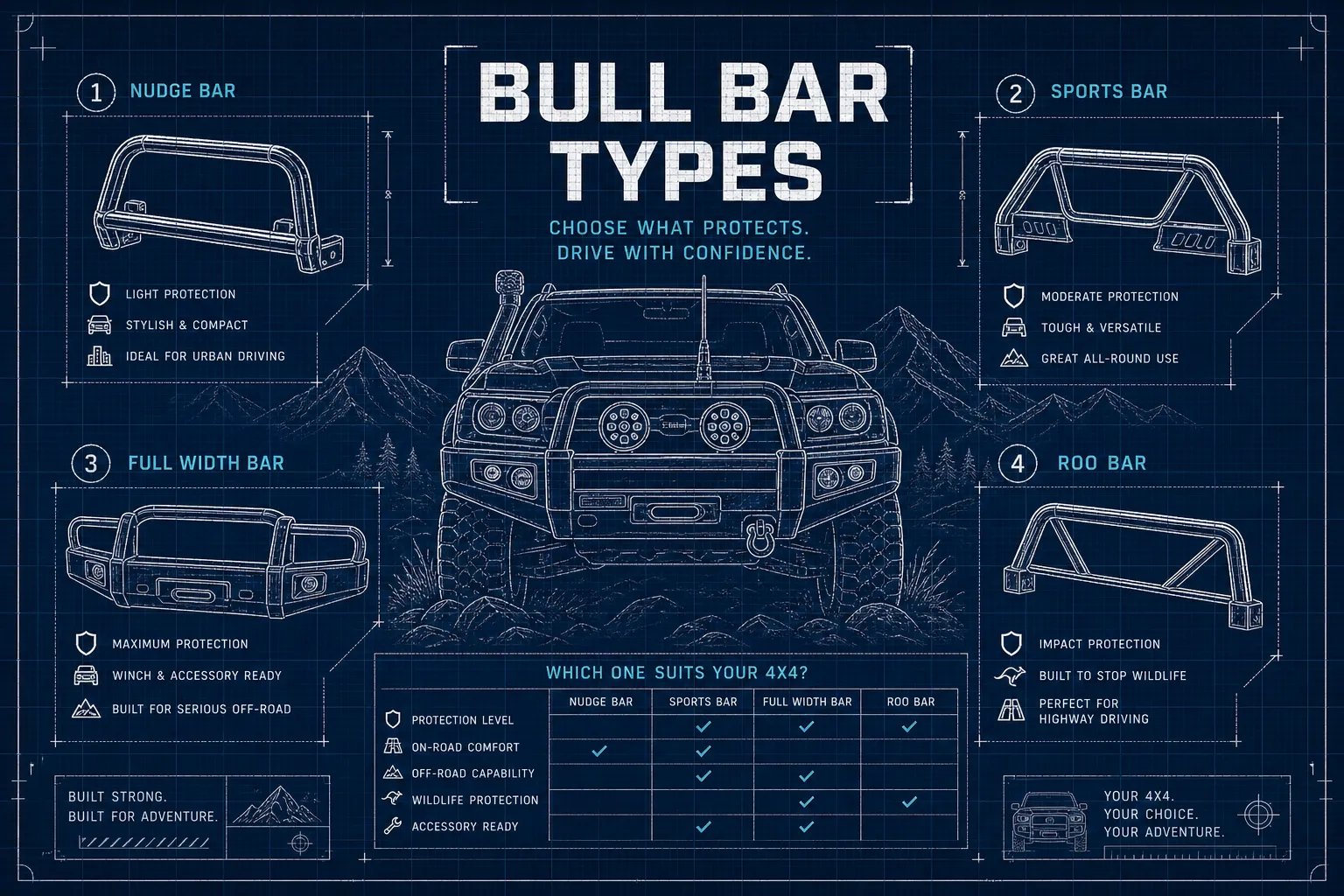
Picture this: you're on the website, two bull bars pulled up side by side, both listed as fitting your vehicle, both from reputable brands. One looks like it belongs on a highway patrol ute. The other looks like it could push a cow through a fence. Same vehicle, wildly different bars, and no obvious clue about which one actually suits the way you drive. Understanding the main bull bar types, and what each one is actually built for, is what closes that gap.
This is the exact conversation the team at Brixton 4x4 has every week, with everyone from suburban commuters who want a bit of front-end protection through to seasoned outback tourers planning months in the scrub. The answer is never one-size-fits-all, because different bar styles serve genuinely different purposes. Getting it wrong means either carrying unnecessary weight and bulk, or rolling into country that demands real protection with a bar that was never built for it.
By the end of this guide, you'll know the key types of bull bars, how materials change the equation, what ADR compliance actually means for your safety, and which option makes the most sense for your specific driving reality.
Bull bar types: the four main styles and what sets them apart

The core principle across all bull bar types is straightforward: more coverage equals more protection, but also more weight, more cost, and greater visual bulk. Understanding where each style sits on that spectrum makes the rest of the decision a lot easier.
Nudge bars: light protection with a clean look
A nudge bar is a low-mounted, minimalist option designed for light impacts and cosmetic protection, not serious animal strikes. It preserves the vehicle's factory lines and forward visibility better than any other style, which makes it a natural fit for city and suburban drivers who want some front-end defence without the visual weight of a full bar. If your driving is mostly bitumen with the occasional dirt road, a nudge bar does the job without overcomplicating your build.
It's worth being clear on the nudge bar vs bull bar distinction here: a nudge bar is not a substitute for a full bull bar in high-risk environments. It's a sensible choice for light use, not a scaled-down version of the same thing.
Single loop and double loop bars: the mid-range sweet spot
A single hoop bull bar rises from the bumper to cover the grille and radiator, giving solid moderate protection for regional driving and gravel roads. A double loop bar adds outer hoops for wider frontal coverage and greater impact resistance, which becomes genuinely useful on highways through wildlife-heavy country. The double loop is the right call for drivers who face a real animal-strike risk but don't need the full commitment of a wider bar. Both styles offer a practical balance between protection, weight, and forward visibility.
Full-width bars: the right choice for serious country driving
Full-width bars cover the entire front end and represent the maximum-protection option available. The trade-off is clear: more weight (typically 80 to 90 kg for a steel unit on a LandCruiser), more visual bulk, higher cost, and greater complexity around sensors and airbag compatibility. For remote outback travel, extended touring, or high-risk wildlife corridors, that trade-off is absolutely worth it. For a weekend camper who mostly stays on formed tracks, it usually isn't.

Steel, alloy, or polymer: choosing the right material
Once you've settled on a bar style, the material question carries just as much weight. The right choice depends on where you drive, how hard you use the vehicle, and whether you're building for maximum protection or trying to keep weight and cost manageable.
Why steel still leads for remote and outback travel
Steel delivers maximum impact resistance and has a proven track record in hard-use applications. One major practical advantage is repairability: a steel bar that takes a hit in the field can often be bent back, welded, or reworked well enough to keep you moving. The downsides are real, though. Steel is the heaviest material on this list, and in coastal or humid conditions it will rust without proper maintenance and regular inspection.
When alloy makes more sense for your build
Aluminium alloy bars are significantly lighter than steel and don't rust, which makes them a strong choice for drivers who need solid protection without punishing their suspension or fuel economy. The limitation is worth knowing upfront: alloy is less forgiving in a major impact and much harder to repair after a serious hit. If your alloy bar takes a heavy strike, replacement is usually the outcome rather than a field repair. For regional touring and highway driving, that trade-off works well. For remote single-track outback travel, steel's repairability edge becomes more relevant.
Polymer bars: a practical choice for lighter use
Polymer bars are the lightest option and completely corrosion-proof, which suits urban rigs or vehicles where the driver wants minor front-end protection without affecting suspension or efficiency. They are not designed to handle large animal strikes, and their structural strength is considerably lower than metal alternatives. Think of a polymer bar as a cosmetic and low-impact protection choice rather than a serious off-road safety feature.
Cost and weight: what you're really signing up for
Budget and weight are two factors that catch buyers off guard when comparing bar options. Getting a realistic handle on both upfront saves a lot of headaches after the purchase.
In general terms, polymer and nudge bars sit at the lower end of the market. Alloy bars occupy the mid-range, offering a good balance of price and performance for most buyers. Steel full-width bars from reputable brands typically range from roughly AUD 1,000 up to AUD 4,500 or more for heavy-duty commercial-grade options. Winch-compatible bars and those with integrated sensor housings, driving light mounts, and recovery points naturally sit toward the upper end of that range.
Weight deserves equal attention. A heavy steel bar can add 50 to 100 kg to the front axle, shifting the centre of gravity forward, increasing wear on front suspension components, and adding to fuel consumption over time. At low speed, steering can feel noticeably heavier. None of this means you shouldn't fit a steel bar, but it does mean the bar weight should match your actual use. There's no practical benefit in fitting a 90 kg commercial-grade bar to a vehicle that spends 90 per cent of its life on suburban roads. You can read more about how a bull bar affects the vehicle's weight for a deeper look at typical mass and its implications.
ADR compliance and airbag compatibility: what every Aussie buyer must verify
This section matters more than any other for your safety and for your legal standing on Australian roads. Fitting a non-compliant bull bar isn't just a paperwork issue; it can disable your airbags in a crash.
How the wrong bar can interfere with your vehicle's crash systems
Modern vehicles rely on specific crash pulse data from the front crumple zone to trigger airbags at the correct moment. A rigid bar that attaches ahead of that crumple zone can prevent the front of the vehicle from deforming naturally, distorting the pulse and causing airbags to fire late, fire early, or not deploy at all. ADR 69/00 and ADR 73/00 require any frontal protection system to preserve the vehicle's crash performance. Quality ADR-compliant bull bars address this through crush cans or deformable mounting brackets that allow the bar to compress with the crumple zone, replicating the factory crash pulse. For official guidance on design and construction of light-vehicle front protection systems, see the state guidelines on design and construction for front protection systems.
Vehicles with forward-facing driver-assist systems add another layer to consider. Adaptive cruise control, autonomous emergency braking, and lane-departure systems rely on radar and cameras mounted in the front bumper area. A poorly designed bar can physically block sensor sightlines or reflect radar signals in ways that generate false readings or disable those systems entirely.
Any bar fitted to a vehicle with these systems needs purpose-built sensor housings or cutouts designed into the bar itself. This isn't a minor detail, it's a functional requirement that should be confirmed with the manufacturer before you purchase. You can also read about how modern bull bar design balances structural strength with airbag compatibility and sensor considerations in industry commentary on airbag compatibility in modern bull bar design.
What to check before you commit to a bar
Run through this checklist before purchasing any bull bar for an Australian-registered vehicle: Bullbar Purchase Checklist
- Confirm the bar explicitly states airbag compatibility for your specific vehicle model, not just a general vehicle category.
- Look for evidence of physical crash testing rather than self-declared compliance; NATA-accredited testing provides documented proof the bar preserves your SRS function.
- Check that sensor housings or cutouts are designed into the bar if your vehicle has forward-facing driver-assist technology.
- Keep the manufacturer's compliance certificate on hand for insurance and registration purposes; a non-compliant modification can affect both your registration status and your ability to make a claim.
Winch capability, driving lights, and planning your accessory build
For drivers building a touring or recovery-capable rig, the bull bar is the foundation for everything mounted at the front of the vehicle. Planning that layout before you buy the bar saves significant cost and frustration later.
Full-width steel bars are the primary candidates for a front-mounted winch, with many designed to accommodate winches rated from 9,500 to 12,000 lbs depending on vehicle class. A mid-size ute like a Mitsubishi Triton bullbars or Mazda BT-50 typically suits a 10,000 lb winch, while larger platforms like a LandCruiser can support up to 12,000 lbs in the right bar. Single and double loop bars can sometimes support a winch depending on the specific manufacturer's design, but this needs to be confirmed against the bar's rated winch capacity before purchasing. Nudge bars and polymer options are not rated for winch loads. If you're unsure what winch size suits your vehicle and recovery needs, see expert guidance on what size winch do I need for my 4x4.
Beyond the winch, quality bars come with pre-integrated mounts for driving lights, CB aerials, and recovery points. Winch wiring requires heavy-duty cabling rated typically at 150 to 200 amps, with a dedicated fuse and relay setup and a solid chassis ground. Plan the full accessory layout before committing to a bar, because running out of mounting points or needing to rewire after the fact adds unnecessary cost and complexity to what should be a clean build.
Matching bull bar types to how you actually drive
Where do you actually spend your time, and what does that environment demand from the front of your vehicle? Those two questions cut through most of the noise around bar selection.
For urban and light off-road use, a nudge bar or single loop alloy bar gives you meaningful front-end protection without adding unnecessary weight or bulk. These options are generally more affordable, preserve better forward visibility, and suit vehicles that spend the majority of their time on bitumen with occasional gravel or light tracks.
For weekend touring and serious outback travel, a double loop or full-width steel bar is the right call. Regional highways through wildlife country, corrugated outback tracks, and remote single-trail driving all demand real protection. If recovery gear is part of the plan, winch compatibility needs to be confirmed at the bar selection stage, not as an afterthought.
Brixton 4x4 carries the full range of bull bar types, from nudge bars through to full-width steel bars, with vehicle-specific fitment guides for popular models including the LandCruiser 70, 200, and 300 Series, Mitsubishi Triton, Nissan Navara, Mazda BT-50, and more. The team can assist with fitment queries, sensor compatibility checks, and accessory quotes via online chat before you commit to a purchase. If you want a brand-by-brand comparison before you decide, check the Bull Bar Buyer's Guide to compare brands and features side by side.
The short version before you shop
Bar style determines the level of coverage and the weight penalty. Material determines durability, corrosion resistance, and your repair options in the field. ADR compliance is non-negotiable for both your safety and your legal standing. Winch and accessory compatibility needs to be confirmed upfront, not assumed.
The right bar isn't the most aggressive-looking one on the page. It's the one that matches where you actually drive, what you actually face on the road, and what you've got planned for the rest of your build. A nudge bar on a city ute is a smart choice. A full-width steel bar on a remote touring LandCruiser is a smart choice. The same bar in the opposite application is the wrong choice.
Browse all bull bar types by vehicle model at Brixton 4x4, compare brands side by side, and talk to the team before you buy. Getting the right bar from the start is always easier than changing it after the fact. For additional reading on pedestrian safety testing of bull bars, see independent research into pedestrian safety testing of bull bars.