


Bull Bar Buying Guide for LandCruiser Owners
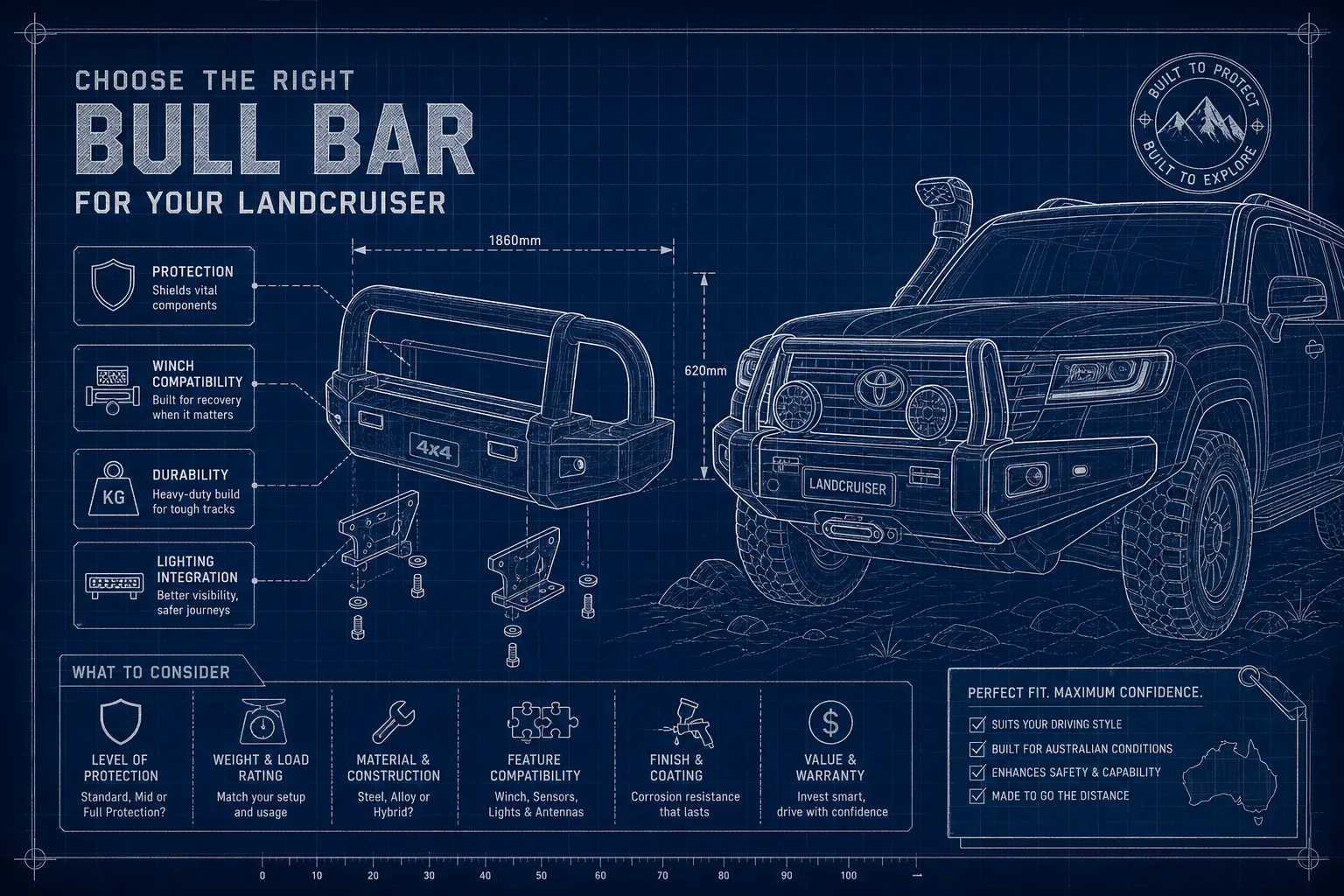
Picking the wrong bull bar for your LandCruiser isn't just a cosmetic mistake. It can delay airbag deployment in a crash, void your new-car warranty, and leave you stranded after a highway roo strike because the bar can't be repaired in the field. Whether you're running a 70 Series on outback stations, a 200 Series on the family touring rig, or a brand-new 300 Series you don't want to get wrong the first time, the decisions you make before you buy matter as much as the bar itself. This bull bar buying guide for LandCruiser owners covers every decision that counts, so you get it right before the bar goes on, not after.
From series-specific fitment and materials through to ADR compliance, winch integration, and real installation costs, there's more to buying a bull bar for your LandCruiser than picking a brand you recognise. Shopping from a model-specific catalogue is the fastest way to filter out bars that won't work for your vehicle before you read a single product page, which is exactly how Brixton 4x4 structures their LandCruiser range. For a quick primer on what to consider before you shop, see our What Should I Know Before Buying a Bull Bar for My 4WD in Australia?
Series fitment: why your LandCruiser model changes everything
The 70, 200, and 300 Series LandCruisers have fundamentally different front-end architecture. The 70 Series runs a comparatively simple steel bumper setup with straightforward chassis mounting points, which is why many aftermarket bars advertise broad 70/76/78/79 compatibility. The 200 Series moves to a plastic fascia with a crash bar and chassis mounting arrangement that requires a bar specifically engineered around that structure. The 300 Series adds front radar, cameras, and lane assist sensors embedded in a composite fascia, making fitment the most complex of the three generations.
A bar listed as "LandCruiser compatible" without a series reference is a red flag, not a reassurance. If the product listing doesn't call out your specific series, treat it as unverified and ask before you buy.
If you're running a 200 Series, the year matters too. Pre-2016 and post-2016 (facelift) 200 Series have different bumper profiles and sensor arrangements, which is why brand-specific SKUs from ARB, TJM, and Ironman 4x4 differ between those two production windows. Confirming your build year, not just your series, is non-negotiable.
On the 300 Series, the challenge is ADAS. Not every bar on the market has been tested with the 300 Series front radar and camera system. You need a compliance statement that references your exact year and variant, confirmed by the manufacturer in writing, before committing to a purchase.
Nudge bar vs bull bar: what the difference means for your LandCruiser
It's worth understanding the distinction between a nudge bar and a full bull bar before you commit to either. A nudge bar is a lighter, partial-width bar that typically protects the grille and number plate area but offers no chassis-level protection and limited animal strike resistance. A full bull bar wraps around the front of the vehicle, mounts to the chassis, and is designed to absorb and redistribute impact energy in a serious collision.
From a compliance standpoint, both nudge bars and bull bars need to satisfy relevant ADRs and AS 4876.1 requirements for your specific vehicle. However, a nudge bar's reduced coverage means it provides far less protection in a high-speed animal strike, an important consideration for anyone travelling remote or regional roads at dusk. For most LandCruiser owners doing any meaningful outback or rural driving, a full bull bar is the appropriate choice. A nudge bar may suit urban or light touring use where aesthetic protection is the primary goal.
Steel vs aluminium: choosing the right material for how you use your LC
Aluminium bars are significantly lighter than steel, which reduces strain on your front suspension and helps keep you within your Gross Combined Mass when you're also carrying a winch, fridge, and towing a caravan. For LandCruiser owners who spend most of their time on formed roads or don't anticipate serious animal strikes, aluminium is a practical choice. It also delivers natural corrosion resistance, making it well suited to coastal and tropical environments where steel requires consistent maintenance to stay rust-free.
Steel bars carry real weight, but they bring something aluminium can't match: repairability after a hard impact. A steel bar that takes a serious roo strike can be bent back, welded at a rural workshop, or at least remain structurally serviceable. Aluminium is more likely to crack, warp, or fold on a heavy hit, which can leave you in a difficult position hundreds of kilometres from the nearest 4x4 workshop.
If you regularly drive roo country at dusk or spend time on remote outback tracks, steel is the more practical long-term choice, regardless of its weight penalty. The trade-off is worth it when repairability after a strike matters more than saving 20 kilograms off the nose. For a focused comparison of the two materials, see this practical analysis of steel vs alloy bull bars.
Airbag compatibility and ADR compliance: the check you can't skip
Australian Design Rules 69/00 and 73/00 cover frontal impact occupant protection and airbag timing. ADR 42/04 covers general safety requirements including protrusions. AS 4876.1 is the key Australian Standard for vehicle frontal protection systems, covering both design requirements and pedestrian impact performance.
None of these standards are automatically satisfied by a bull bar sitting on a shelf. Each one must be assessed for your specific vehicle model, not just the LandCruiser range broadly.
Compliance is vehicle-specific, not generic. A bar that's ADR compliant on a pre-facelift 200 Series is not automatically compliant on a 300 Series. Ask the seller for a written compliance statement that references AS 4876.1 and the relevant ADRs for your exact series and year. Confirm the manufacturer has assessed the bar's effect on the SRS, airbag sensors, and, on the 300 Series, the ADAS systems. If the seller can't provide a model-specific compliance claim, treat the bar as unverified and move on. For a clear overview of bull bar testing and compliance guidance, consult this industry resource on bull bar standards and compliance.
A non-compliant bar that delays or prevents airbag deployment in a crash has consequences well beyond a fine. Your insurer may complicate or reject a claim involving a modified vehicle that lacks compliance documentation, and a workshop may refuse to sign off on a non-ADR bar during a roadworthy inspection. Keep the manufacturer's compliance statement and the installer's invoice together from day one.
Planning for extras: winch mounts, light bars, and sensor clearance

Not all bull bars include an integrated winch tray, and not all integrated trays are rated to carry the same load. Confirm the winch rating on the bar's mounting plate before you buy, a common benchmark for serious touring setups is around 4,300 kg (approximately 9,500 lb), and check that the tray depth won't compromise your approach angle. On the 200 and 300 Series, a deep winch tray that drops below the chassis line can create real issues on steep descents and rocky approaches.
Light bar mounting is worth thinking through at the buying stage rather than retrofitting later. Some bars include a factory light bar pocket or hoop that keeps the light within the bar's profile, which avoids approach angle issues and keeps the installation clean. External mounts that position a light bar above the recommended height can exceed legal limits on a registered vehicle, so confirm the mounting position against your state's vehicle standards before ordering.
On post-facelift 200 Series and all 300 Series vehicles, parking sensors and front cameras need to be accommodated by the bar's design or relocated by the installer. ARB, TJM, and Offroad Animal engineer sensor provisions into their LandCruiser-specific bars; the TJM Signature, for example, includes provision for OE front parking sensors as standard alongside an integrated winch mount and improved approach angle. Aftermarket bars without sensor provisions are a fitment risk and can leave you with a non-functioning parking system after the install.
Top brands worth shortlisting for your LandCruiser
ARB, TJM, and Ironman 4x4 are among the most widely fitted brands across all three LandCruiser series, with strong installer networks around Australia. ARB's Summit, Zenith, and Sahara ranges are confirmed airbag compatible for the 200 Series and include winch and sensor provisions across multiple SKUs.
TJM's ADR-compliant range covers the 200 Series with Sahara and Outback options. Ironman 4x4 offers LED fog light integration on select models and confirms ADR compliance for both the 200 and 300 Series. All three carry solid parts availability, which matters when you need a replacement bracket or trim piece years after the initial install.
Hamer 4x4, Offroad Animal, and Rival are worth adding to your shortlist, particularly if budget is a factor. Offroad Animal's Predator bar is explicitly listed as ADR compliant and airbag compatible for the 300 Series from 2021 onwards. Rival covers 70 Series platforms with competitive steel options. Prices across this tier are often more accessible, but model-specific compliance documentation remains a firm requirement, the price point doesn't change that obligation. Recent coverage has highlighted airbag-compatible bullbar options for the 70 Series appearing in the market, which illustrates how fitment and compliance are evolving.
Brixton 4x4 stocks Hamer 4x4, Offroad Animal, and Rival across their LandCruiser range, with the catalogue organised by series so you're browsing bars pre-filtered for your 70, 200, or 300 Series from the start. Rather than trawling through generic fitment charts, you can narrow the field quickly and get expert advice via online chat for anything that needs a second opinion. Australia-wide delivery and a price match guarantee mean you're not paying a premium for the convenience of getting the right fit the first time.
Ready to choose your bar? Use this bull bar buying guide for LandCruiser owners as your reference
A bull bar is one of the highest-impact upgrades you can put on a LandCruiser, in terms of protection, and in terms of how much can go wrong if the wrong bar ends up on the wrong vehicle. Getting the series fitment right, verifying genuine ADR and airbag compliance, planning ahead for the extras you'll eventually want, and using a qualified installer makes the difference between a bar that adds real capability and one that creates problems from the first drive.
Keep this bull bar buying guide for LandCruiser owners handy from shortlist to sign-off. When you're ready to browse, use Brixton 4x4's LandCruiser-specific catalogue to narrow the field with confidence, organised by series, backed by expert advice, and with a price match guarantee so you're not paying over the odds to get the right fit. For a deeper dive into choosing the right brand and model, see our Bull Bar Buyer's Guide, What Bull Bar Brand to Choose in 2023? Browse the range and shortlist your options today.


